

Questions? Talk it through on a free call.
Book a free callIn plain words
Your mind talks you out of helpful things for reasons researchers can describe. Effort costs you now, while the payoff comes later. Skipping brings quick relief, which makes skipping more likely next time. Low mood makes effort feel heavier. Three small tools help: an if-then plan, a very small first step, and noticing the excuse as just a thought.
You know the walk would help. You tell yourself you will go after this email. Then it is 8 p.m., and the couch sounds better. Or the therapist's number has sat in your phone for three weeks, and today does not feel like the right day.
If that is you, this is not a flaw in your character. It is a pattern researchers can describe, and you can work with it. Here is why it happens, and three things that help.
Why doesn't knowing what helps make me do it?
Wanting to change and changing are two different steps. One review pooled 47 experiments in which researchers raised people's intentions on purpose. A medium-to-large rise in intention led to only a small-to-medium rise in behavior (Webb & Sheeran, 2006 (opens in a new tab)). So a gap between wanting and doing is common. Three things may help explain it.
Why does the effort feel bigger than the payoff?
Walking costs you something right now: shoes, heat, twenty minutes. What you get back comes later, and it feels vague. People tend to value what is available now more than what comes later. In a brain-imaging study of money choices, reward-related areas were more active when an option was available right away. Thinking and planning areas were relatively more active when people chose the later reward (McClure et al., 2004 (opens in a new tab)).
Why does skipping feel so good?
You cancel the appointment, and your shoulders drop. That relief is real. It is also a lesson.
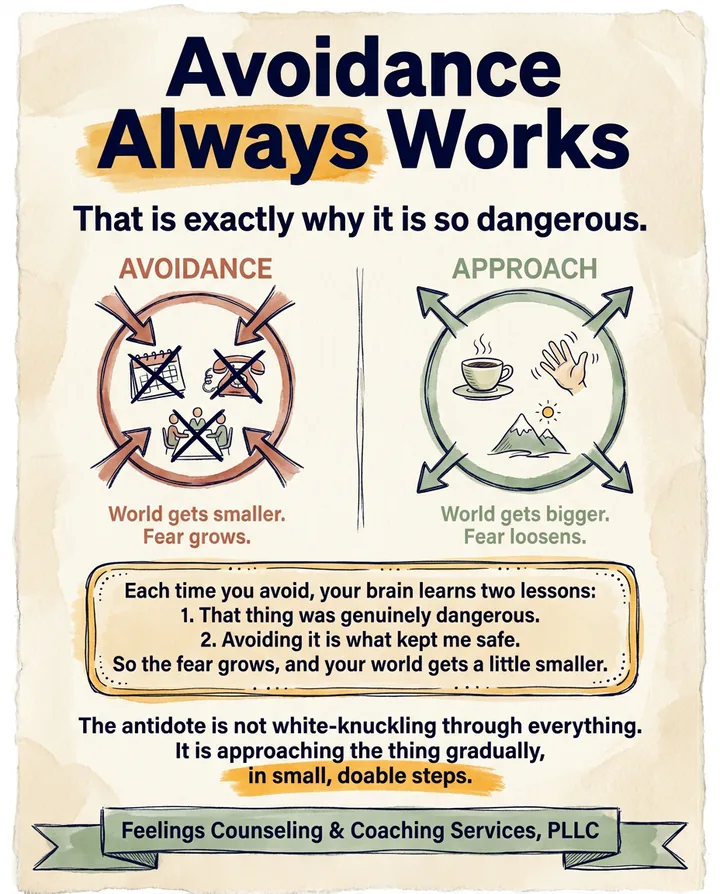
Researchers who study avoidance describe a loop. Escaping the scary thing brings a quick drop in fear, and that drop rewards the escape, at least early on. You also never find out what would have happened, so the belief "that would have gone badly" stays in place (Krypotos et al., 2015 (opens in a new tab)). That research is mostly about fear. A pattern I often see is the same loop with the unopened bill and the unbooked visit.
Why does everything feel heavier when my mood is low?
The National Institute of Mental Health lists loss of interest or pleasure and low energy among the signs of depression. For a diagnosis, symptoms last most of the day, nearly every day, for at least two weeks (NIMH (opens in a new tab)).
A 2026 meta-analysis (a review that pools many studies) combined 68 studies in which people chose how much effort to spend for a reward. In major depression, people put in somewhat less effort for rewards than people without depression. The average difference was small. The authors read the modeling studies as suggesting that effort may weigh more in depression (Pillny et al., 2026 (opens in a new tab)). That is an average, not a rule for every person.
So when the voice says "What is the point?", it may be low mood talking, not the truth. My article on depression symptoms, support and medication goes deeper.
Which voice sounds like yours?
| The voice says | What may be going on | What helps |
|---|---|---|
| "I'll start Monday." | The effort is now, the payoff is later | An if-then plan |
| "I'll cancel. I feel fine now." | Relief rewards skipping | A tiny step, taken anyway |
| "I'm too tired. What's the point?" | Low mood makes effort heavy | Noticing it as a thought, then a tiny step |
What can I do when the voice starts?
1. Make an if-then plan
Decide the moment and the action ahead of time: "If it is 7 p.m., then I put on my shoes and step outside." A review of 94 tests found that plans like this helped people reach goals, with a medium-to-large average effect (Gollwitzer & Sheeran, 2006 (opens in a new tab)). A later review of 28 experiments with people who have mental health problems or high symptom scores found a large effect on reaching goals (Toli et al., 2016 (opens in a new tab)).
Your plan can name the excuse, too: "If I think I'm too tired, then I put on my shoes and decide after five minutes." In two field experiments, plans aimed at cravings and distracting thoughts helped people reach diet and sport goals (Achtziger et al., 2008 (opens in a new tab)).
2. Start smaller than feels useful, and go before you feel ready
Pick a step so small it feels almost silly: shoes on, front door open, two minutes. Then stop if you want to. Starting this small is a habit I teach in my sessions, because a tiny step is hard for the voice to argue with. In my experience, motivation often comes after the first small step, not before.
This fits with behavioral activation (BA), a therapy for low mood. In a UK trial of 440 adults with depression, BA had people plan and schedule specific activities and cut down avoidance. At 12 months, it worked about as well as cognitive behavioral therapy (CBT) (Richards et al., 2016 (opens in a new tab)). A 2021 review of 28 trials found that BA beat comparison groups with no active treatment for depression, but not other active treatments, and study quality was generally low (Stein et al., 2021 (opens in a new tab)).
If your voice says "If I can't do it right, why bother?", my article on perfectionism may fit.
3. Notice the excuse as a thought
Try changing "I'm too tired" into "I'm having the thought that I'm too tired." It sounds small. It puts a little space between you and the voice, so you can hear it without obeying it. In acceptance and commitment therapy (ACT), this skill is called defusion.
A 2026 review of 12 lab studies, with 659 adults who were not recruited as patients, found that defusion made negative thoughts feel less believable and less upsetting on average (Oppo et al., 2026 (opens in a new tab)).
Be honest about the limits. These were short experiments, and they measured how a thought felt, not whether people then did the thing. Think of defusion as one tool, not proof.
Not sure which pattern fits you?
My free depression and anxiety self-checks take a few minutes. They are private, nothing is saved, and they are not a diagnosis. See all of them on the self-check page.
See the self-checksHow can counseling help?
If the voice keeps winning, you do not have to out-argue it alone. In counseling, we look at the pattern: what the voice says, what you do next, and what happens after. Then we build small experiments together.
I draw on CBT, ACT and mindfulness-based cognitive therapy (MBCT) skills, including if-then plans, small scheduled steps, and noticing thoughts without obeying them. If low mood, worry or fear sits underneath, we work on that too. If the hard part is putting words to what you feel, my article on alexithymia may help.
I see adults in person in Sugar Land or online anywhere in Texas, and kids and teens in person in Sugar Land (in some cases online, when we agree together with you and your child or teen that it's a good fit). Sessions are in English, Hindi or Gujarati. You can read more on my depression and anxiety counseling page.
Common questions
Is this laziness or a lack of willpower?
Calling it laziness does not fit the research above. It points to how brains weigh effort, relief and mood. Plans and tiny steps work with that pattern, not against it.
What if I make a plan and still skip it?
It happens. Treat it as information. Ask what the voice said, then shrink the step or move the time. If you keep skipping something that matters, bring it to counseling.
How do I know when it is more than a habit?
If low mood, loss of interest or low energy last most of the day, nearly every day, for at least two weeks, talk with a health care provider (NIMH (opens in a new tab)). A counselor can help, too. If you have thoughts of suicide, call or text 988, or call 911.
What is one small step you can take today?
Sometimes the hardest step is the first call, and the voice is already saying "maybe next week." That is what the free 15-minute call is for. It is a short consultation, not counseling. We talk about what is going on and whether working together fits, with no pressure.
Try an if-then plan right now: "If I finish reading this, then I open the booking page."
This free 15-minute call does not establish a therapist-client/patient relationship as this is not counseling and/or life coaching.
Sources
- Webb TL, Sheeran P. Does changing behavioral intentions engender behavior change? A meta-analysis of the experimental evidence. Psychol Bull. 2006;132(2):249-268. https://pubmed.ncbi.nlm.nih.gov/16536643/ (opens in a new tab)
- McClure SM, Laibson DI, Loewenstein G, Cohen JD. Separate neural systems value immediate and delayed monetary rewards. Science. 2004;306(5695):503-507. https://pubmed.ncbi.nlm.nih.gov/15486304/ (opens in a new tab)
- Krypotos AM, Effting M, Kindt M, Beckers T. Avoidance learning: a review of theoretical models and recent developments. Front Behav Neurosci. 2015;9:189. https://pubmed.ncbi.nlm.nih.gov/26257618/ (opens in a new tab)
- National Institute of Mental Health. Depression. NIMH, U.S. National Institutes of Health. https://www.nimh.nih.gov/health/publications/depression (opens in a new tab)
- Pillny M, et al. Effort-based decision making in psychopathology: a transdiagnostic multilevel meta-analysis and systematic review of behavioral patterns and mechanisms underlying amotivational psychopathology. Psychol Bull. 2026;152(1):33-65. https://pubmed.ncbi.nlm.nih.gov/41785146/ (opens in a new tab)
- Gollwitzer PM, Sheeran P. Implementation intentions and goal achievement: a meta-analysis of effects and processes. Adv Exp Soc Psychol. 2006;38:69-119. https://doi.org/10.1016/S0065-2601%2806%2938002-1 (opens in a new tab)
- Toli A, Webb TL, Hardy GE. Does forming implementation intentions help people with mental health problems to achieve goals? A meta-analysis of experimental studies with clinical and analogue samples. Br J Clin Psychol. 2016;55(1):69-90. https://pubmed.ncbi.nlm.nih.gov/25965276/ (opens in a new tab)
- Achtziger A, Gollwitzer PM, Sheeran P. Implementation intentions and shielding goal striving from unwanted thoughts and feelings. Pers Soc Psychol Bull. 2008;34(3):381-393. https://pubmed.ncbi.nlm.nih.gov/18272806/ (opens in a new tab)
- Richards DA, et al. Cost and outcome of behavioural activation versus cognitive behavioural therapy for depression (COBRA): a randomised, controlled, non-inferiority trial. Lancet. 2016;388(10047):871-880. https://pubmed.ncbi.nlm.nih.gov/27461440/ (opens in a new tab)
- Stein AT, Carl E, Cuijpers P, Karyotaki E, Smits JAJ. Looking beyond depression: a meta-analysis of the effect of behavioral activation on depression, anxiety, and activation. Psychol Med. 2021;51(9):1491-1504. https://pubmed.ncbi.nlm.nih.gov/32138802/ (opens in a new tab)
- Oppo A, Pasquini L, Misitano A, Savoia A, Presti G. Defusion techniques on self-referential thought in laboratory-based experimental research: a meta-analysis of believability and discomfort outcomes. J Contextual Behav Sci. 2026;40:100999. https://doi.org/10.1016/j.jcbs.2026.100999 (opens in a new tab)
This article is general information, not a diagnosis or a substitute for care. If you are in crisis, call or text 988, or call 911.