

Questions? Talk it through on a free call.
Book a free callIn plain words
Depression is more than sadness. It means low mood or lost interest, plus signs like poor sleep, low energy and trouble concentrating, for at least two weeks. It feeds itself through doing less, harsh thinking and pulling away. It is treatable. Counseling, family support and, for many people, medicine from a doctor can help.
You tell yourself it is just stress. You will feel better after the weekend, or after this deadline. Weeks go by. You are tired in a way sleep does not fix, and you wonder why everyone else seems to manage.
Depression is common. In a 2021 to 2023 national survey, about 13 percent of people age 12 and older scored in the depression range on a standard questionnaire about the past two weeks. Fewer than 4 in 10 of them had received counseling or therapy in the past year (CDC (opens in a new tab)).
Is this sadness, or is it depression?
The National Institute of Mental Health puts it simply: "Everyone feels sad or low sometimes, but these feelings usually pass." Depression is different. It changes how a person feels, thinks and handles daily life (NIMH (opens in a new tab)).
| Sadness | Depression | |
|---|---|---|
| How long | Usually passes with time (NIMH (opens in a new tab)) | Most of the day, nearly every day, for at least 2 weeks (NIMH (opens in a new tab)) |
| Daily life | Heavy, but you keep going | A clear change in work, school, relationships or hobbies (APA (opens in a new tab)) |
What are the nine signs of depression?
Clinicians use the DSM-5-TR, the manual for diagnosing mental health conditions. It lists nine signs of a major depressive episode. You need five or more in the same two weeks, as a change from how you usually are. One must be low mood or loss of interest. They must also cause real distress or trouble functioning (SAMHSA (opens in a new tab); AAFP (opens in a new tab)). The 2022 text revision kept the same nine signs and only updated the wording about suicide (APA (opens in a new tab)).
- Low mood. Sad, empty or hopeless for most of the day, nearly every day. In children and teens, it may look like irritability instead of sadness (NIMH (opens in a new tab); SAMHSA (opens in a new tab)).
- Loss of interest. Things you used to enjoy feel flat.
- Sleep. Trouble falling asleep, waking too early, or sleeping far more than usual.
- Guilt. Feeling worthless, or blaming yourself far more than the situation calls for.
- Energy. Tired all the time, even after rest. Small jobs, like answering a text, feel huge.
- Concentration. Trouble focusing or remembering. Even small decisions feel hard.
- Appetite. Eating much less or much more than usual, sometimes with weight loss or gain you did not plan.
- Psychomotor changes. Mood showing up in how the body moves. You may be slowed down, with slow speech and heavy steps, or restless and unable to sit still. Others can often see it.
- Suicidal thoughts. Thoughts of death or suicide, from wishing you would not wake up to thinking about ending your life. This is a symptom of the illness, not a character flaw, and it is a reason to reach out. If you are having thoughts of suicide, call or text 988, or call 911. The 988 Lifeline (opens in a new tab) is free, confidential and open 24 hours a day.
Depression can also show up in the body, as aches, headaches or stomach trouble with no clear cause. Not everyone has every sign (NIMH (opens in a new tab)). If a few signs are wearing you down, that is still worth checking with a professional.
What are the three downward spirals?
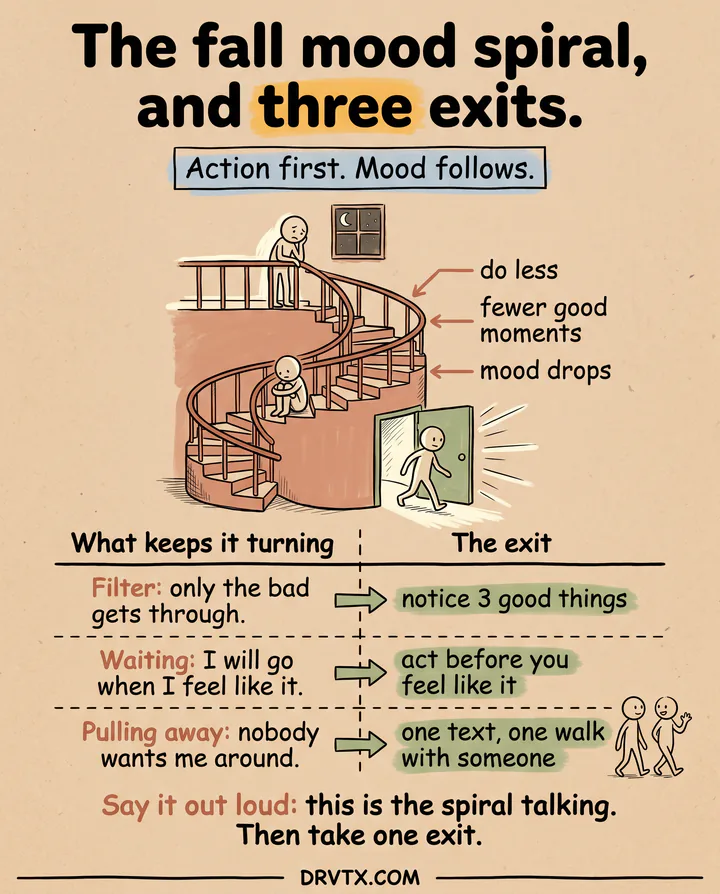
Depression feeds itself. I think of three spirals, and each one strengthens the others.
Spiral 1: Doing less
You feel flat and tired, so you cancel plans, skip the walk and stop cooking. Researchers describe this loop: low mood leads to avoidance, less social contact and fewer rewarding moments, which deepens the low mood (Dimidjian et al., 2011 (opens in a new tab)).
The way out is small, planned steps taken before you feel like it. This is called behavioral activation. In a trial of 440 adults, it worked no worse than CBT (Richards et al., 2016 (opens in a new tab)), and NICE lists it as a first-line option (NICE (opens in a new tab)). For why your mind argues with these steps, see why the mind talks you out of what helps.
Spiral 2: The thinking spiral
Your mind starts to loop: Why am I like this? What is wrong with me? This is rumination: going over the same thoughts again and again. Research suggests it worsens depression, feeds negative thinking, hurts problem solving and wears down support from others (Nolen-Hoeksema et al., 2008 (opens in a new tab)).
Depression also tilts the view: I am worthless, the world is against me, it will never get better. Clinicians call this the cognitive triad: a negative view of self, world and future. A 2026 review of 59 studies found a strong link between this thinking and depression symptoms. Early follow-up data suggest each can feed the other, at least from the mid-teens on (Huang et al., 2026 (opens in a new tab)).
Spiral 3: Pulling away and not talking about it
This one is quiet. You say I'm fine. You do not want to worry anyone, or you grew up where feelings were not discussed. When you stop talking, people stop knowing. Support fades, and the first two spirals run with no one to interrupt them.
A review of 34 studies found that people with depression who felt less supported had more symptoms, slower recovery and more trouble in daily life (Wang et al., 2018 (opens in a new tab)). The way out is small: tell one safe person one true sentence, like I have not been myself for a few weeks. If naming feelings is hard, read my article on alexithymia.
Why can't I just shake it off?
Because depression takes the very tools you would use: energy, motivation and clear thinking. A 2014 review found moderate problems with focus, memory and planning in people with depression, some lasting after mood improved (Rock et al., 2014 (opens in a new tab)). Telling yourself to try harder asks for energy you do not have.
Depression also has more than one cause. NIMH says genetic, biological, environmental and psychological factors all play a role (NIMH (opens in a new tab)).
Why does a depressed person sometimes push family away?
You offered help and got snapped at, or met with silence. It is usually not about you. Common reasons:
- Irritability is a symptom. NIMH lists irritability and frustration among the common signs (NIMH (opens in a new tab)). A short temper may be the illness talking.
- Guilt. Feeling worthless or overly guilty is a symptom (APA (opens in a new tab)). Help can feel like proof of being a burden.
- No energy. Even answering a kind question takes effort.
- Shame. I should handle this myself.
- Advice that sounds like blame. Just go for a walk can sound like you are not trying.
If you are the one with depression, pushing people away does not make you a bad person. Try: It is not you. I am worn out.
How can family really help?
What to say. Keep it short and warm: I have noticed you seem down, and I care about you. I can just sit with you. Listen without judging (NIMH (opens in a new tab)). It is fair to remind them that with time and treatment, depression can lift (NIMH (opens in a new tab)).
What not to say. Skip snap out of it, think positive and other people have it worse. They add shame. In research, a critical or hostile family climate (called high expressed emotion) predicted relapse in mood disorders (Butzlaff & Hooley, 1998 (opens in a new tab)).
Practical help. Let me know if you need anything is hard to answer. Can I bring dinner Thursday? is easy. Offer rides and medicine reminders (NIMH (opens in a new tab)).
Small invitations. Invite them out, as NIMH suggests (NIMH (opens in a new tab)): a ten-minute walk, or company in the kitchen. If they say no, ask again later.
Encourage care. Help them see a doctor, who can check for medical causes such as thyroid disorders (NIMH (opens in a new tab)), and a counselor. Offer to come along. NICE notes people can bring a family member or friend to treatment (NICE (opens in a new tab)).
Warning signs. Talk of wanting to die, feeling trapped, being a burden, giving things away, saying goodbye, or more alcohol or drug use (NIMH (opens in a new tab)). Ask directly: Are you thinking about suicide? Studies show asking does not increase suicidal thoughts (NIMH (opens in a new tab); Dazzi et al., 2014 (opens in a new tab)). Help them connect with 988 and put dangerous items out of reach (NIMH (opens in a new tab)). If danger is immediate, call or text 988, or call 911.
Take care of yourself. Protect your own sleep, friends and breaks. When you feel better, you can take better care of your loved one (MedlinePlus (opens in a new tab)).
When is medication needed, and what should I expect?
I am a Licensed Professional Counselor, and I do not prescribe medication. A primary care doctor, psychiatrist or psychiatric nurse practitioner does. With your written consent, I can coordinate with them.
When is it usually considered?
- Moderate to severe depression. NIMH says milder depression often starts with therapy, while moderate or severe depression usually includes medicine from the start (NIMH (opens in a new tab)). NICE agrees, and does not offer medicine routinely for less severe depression unless you prefer it. For more severe depression, it puts CBT plus an antidepressant first, but all its options are first-line (NICE (opens in a new tab)).
- Symptoms that last or keep returning, serious trouble functioning, or a past good response. NICE judges severity by symptoms, how long they last and how much they disrupt daily life. It asks what has helped you before, and lists repeated episodes as one reason relapse is more likely (NICE (opens in a new tab)).
- Urgent evaluation. If you have thoughts of suicide, or you are losing touch with reality (seeing or hearing things that are not there, or holding strong false beliefs), do not wait. Call or text 988, or call 911. NICE calls for urgent referral when risk is immediate, and specialist care for psychotic symptoms (NICE (opens in a new tab)).
Tell your doctor about any past stretch of unusually high mood or energy. It can be a sign of bipolar disorder, which needs a different plan (NICE (opens in a new tab)).
What can medicine do, and what can't it do?
In a review of 522 short-term trials with over 116,000 adults, all 21 antidepressants studied worked better than placebo (Cipriani et al., 2018 (opens in a new tab)). Severity matters. In one analysis of six trials, the extra benefit over placebo was small on average for mild or moderate symptoms and large for very severe depression (Fournier et al., 2010 (opens in a new tab)).
Medicine plus counseling often works better than either alone. A review of 52 trials (32 on depression) found combined treatment beat antidepressants alone for major depression (Cuijpers et al., 2014 (opens in a new tab)). Another found it beat therapy alone, though it is unclear how much that gap matters in daily life (Cuijpers et al., 2009 (opens in a new tab)).
| Medication can | Medication cannot |
|---|---|
| Ease symptoms like low mood, poor sleep and low energy; sleep, appetite and energy often improve before mood (NIMH (opens in a new tab)) | Fix relationship problems, ongoing stress or money problems, which can keep raising relapse risk (NICE (opens in a new tab)) |
| Lower the chance of depression returning when continued as advised (NICE (opens in a new tab)) | Teach skills like behavioral activation or stepping out of rumination |
| Be one part of a plan that includes counseling (NIMH (opens in a new tab)) | Work overnight |
What should I expect?
- Time and side effects. Antidepressants usually take 4 to 8 weeks to work. Upset stomach, headache and sexual problems are common, usually mild, and often fade (NIMH (opens in a new tab)). Tell your prescriber instead of quitting.
- Trying more than one. It may take several tries to find the right medicine (NIMH (opens in a new tab)). If one does not help, other options exist (NICE (opens in a new tab)).
- Keep going after you feel better, as advised. Guidelines usually suggest at least six months after symptoms improve (APA (opens in a new tab); NICE (opens in a new tab)).
- Never stop suddenly. MedlinePlus says: "Never stop taking antidepressants without your provider's help." (MedlinePlus (opens in a new tab)). Stopping suddenly can cause discontinuation symptoms, like dizziness, nausea and poor sleep (FDA label (opens in a new tab); NICE (opens in a new tab)). These are not the same as the depression coming back. When the dose is lowered in steps with the prescriber, most people stop successfully (NICE (opens in a new tab)).
- A boxed warning under age 25. The FDA's boxed warning says antidepressants can raise suicidal thoughts in some children, teens and young adults, mostly in the first few months. Studies did not show this in adults over 24. Call the prescriber right away about new or worse suicidal thoughts, agitation or sudden mood changes. The Medication Guide adds that depression and other serious mental illnesses are the most important causes of suicidal thoughts (FDA label (opens in a new tab)).
How can counseling help with depression?
In my sessions I use cognitive behavioral therapy (CBT) and behavioral activation. We pick one of your three spirals to interrupt first. See how counseling for depression works.
- Behavioral activation. We plan small steps tied to what matters to you: a short walk, a call, a meal. You do them before motivation shows up.
- CBT. We spot the thoughts that feed the loop and test them gently. We also practice stepping out of rumination with a mindful pause.
NIMH names CBT as an evidence-based therapy for depression (NIMH (opens in a new tab)).
I see adults in person in Sugar Land or online anywhere in Texas. I see kids and teens in person in Sugar Land, and in some cases online, when we agree together with you and your child or teen that it's a good fit. Sessions are in English, Hindi or Gujarati.
Not sure where you stand?
The depression self-check takes a few minutes. It is private, nothing is saved, and it is not a diagnosis.
Take the self-checkCommon questions
Do I have to take medication to get better?
Not always. For milder depression, therapy is often tried first, and the choice is yours. For moderate or severe depression, medicine is often part of the plan, so talk it through with a prescriber (NIMH (opens in a new tab); NICE (opens in a new tab)).
How long does counseling for depression take?
It varies. APA says real improvement can often come in 10 to 15 sessions (APA (opens in a new tab)). For one-on-one CBT or behavioral activation, NICE lists about 8 sessions for less severe depression and 12 to 16 for more severe (NICE (opens in a new tab)).
What if my family member refuses help?
You cannot force an adult. Stay in touch and ask again later. NIMH notes that staying in touch after a crisis can make a difference (NIMH (opens in a new tab)). If you see warning signs, ask directly and call or text 988.
Want to talk it through?
If this sounds like you or someone you love, you do not have to sort it out alone. You can book a free 15-minute call. It is a short consultation, not counseling. We talk about what is going on and whether working together makes sense.
This free 15-minute call does not establish a therapist-client/patient relationship as this is not counseling and/or life coaching.
Sources
- Centers for Disease Control and Prevention, National Center for Health Statistics. Depression Prevalence in Adolescents and Adults: United States, August 2021-August 2023 (NCHS Data Brief No. 527). 2025. https://www.cdc.gov/nchs/products/databriefs/db527.htm (opens in a new tab)
- National Institute of Mental Health (NIMH). Depression (NIH Publication No. 24-MH-8079). Revised 2024. https://www.nimh.nih.gov/health/publications/depression (opens in a new tab)
- American Psychiatric Association. What Is Depression? (physician review April 2024). https://www.psychiatry.org/patients-families/depression/what-is-depression (opens in a new tab)
- Substance Abuse and Mental Health Services Administration. DSM-5 Changes: Implications for Child Serious Emotional Disturbance (Table 9, DSM-5 major depressive episode criteria). 2016. https://www.samhsa.gov/data/sites/default/files/NSDUH-DSM5ImpactChildSED-2016.pdf (opens in a new tab)
- Maurer DM, Raymond TJ, Davis BN. Depression: Screening and Diagnosis. Am Fam Physician. 2018;98(8):508-515. https://www.aafp.org/pubs/afp/issues/2018/1015/p508.html (opens in a new tab)
- 988 Suicide & Crisis Lifeline. https://988lifeline.org/ (opens in a new tab)
- Dimidjian S, et al. The origins and current status of behavioral activation treatments for depression. Annu Rev Clin Psychol. 2011;7:1-38. https://pubmed.ncbi.nlm.nih.gov/21275642/ (opens in a new tab)
- Richards DA, et al. Cost and outcome of behavioural activation versus cognitive behavioural therapy for depression (COBRA): a randomised, controlled, non-inferiority trial. Lancet. 2016;388(10047):871-880. https://pubmed.ncbi.nlm.nih.gov/27461440/ (opens in a new tab)
- National Institute for Health and Care Excellence (NICE). Depression in adults: treatment and management (NG222). Published 29 June 2022. https://www.nice.org.uk/guidance/ng222/chapter/Recommendations (opens in a new tab)
- Nolen-Hoeksema S, Wisco BE, Lyubomirsky S. Rethinking rumination. Perspect Psychol Sci. 2008;3(5):400-424. https://pubmed.ncbi.nlm.nih.gov/26158958/ (opens in a new tab)
- Huang Z, et al. Cognitive triad and depression: a meta-analysis of cross-sectional and longitudinal studies. Clin Psychol Psychother. 2026;33(3):e70282. https://pubmed.ncbi.nlm.nih.gov/42086279/ (opens in a new tab)
- Wang J, et al. Associations between loneliness and perceived social support and outcomes of mental health problems: a systematic review. BMC Psychiatry. 2018;18(1):156. https://pubmed.ncbi.nlm.nih.gov/29843662/ (opens in a new tab)
- Rock PL, et al. Cognitive impairment in depression: a systematic review and meta-analysis. Psychol Med. 2014;44(10):2029-2040. https://pubmed.ncbi.nlm.nih.gov/24168753/ (opens in a new tab)
- NIMH. Warning Signs of Suicide. Revised 2025. https://www.nimh.nih.gov/health/publications/warning-signs-of-suicide (opens in a new tab)
- NIMH. 5 Action Steps to Help Someone Having Thoughts of Suicide. Revised 2024. https://www.nimh.nih.gov/health/publications/5-action-steps-for-helping-someone-in-emotional-pain (opens in a new tab)
- Butzlaff RL, Hooley JM. Expressed emotion and psychiatric relapse: a meta-analysis. Arch Gen Psychiatry. 1998;55(6):547-552. https://pubmed.ncbi.nlm.nih.gov/9633674/ (opens in a new tab)
- Dazzi T, et al. Does asking about suicide and related behaviours induce suicidal ideation? What is the evidence? Psychol Med. 2014;44(16):3361-3363. https://pubmed.ncbi.nlm.nih.gov/24998511/ (opens in a new tab)
- MedlinePlus, National Library of Medicine. Caregivers. Accessed 2026. https://medlineplus.gov/caregivers.html (opens in a new tab)
- NIMH. Mental Health Medications. Last reviewed December 2023. https://www.nimh.nih.gov/health/topics/mental-health-medications (opens in a new tab)
- MedlinePlus, National Library of Medicine. Antidepressants. Updated March 2025. https://medlineplus.gov/antidepressants.html (opens in a new tab)
- U.S. Food and Drug Administration (Drugs@FDA). Prescribing information and Medication Guide for an FDA-approved SSRI antidepressant (the boxed warning on suicidal thoughts and behaviors, the Medication Guide section on suicidal thoughts and the discontinuation syndrome section use class-wide wording). Revised 8/2023. https://www.accessdata.fda.gov/drugsatfda_docs/label/2023/019839s108,20990s062lbl.pdf (opens in a new tab)
- Cipriani A, et al. Comparative efficacy and acceptability of 21 antidepressant drugs for the acute treatment of adults with major depressive disorder: a systematic review and network meta-analysis. Lancet. 2018;391(10128):1357-1366. https://pubmed.ncbi.nlm.nih.gov/29477251/ (opens in a new tab)
- Fournier JC, et al. Antidepressant drug effects and depression severity: a patient-level meta-analysis. JAMA. 2010;303(1):47-53. https://pubmed.ncbi.nlm.nih.gov/20051569/ (opens in a new tab)
- Cuijpers P, et al. Adding psychotherapy to antidepressant medication in depression and anxiety disorders: a meta-analysis. World Psychiatry. 2014;13(1):56-67. https://pubmed.ncbi.nlm.nih.gov/24497254/ (opens in a new tab)
- Cuijpers P, et al. Psychotherapy versus the combination of psychotherapy and pharmacotherapy in the treatment of depression: a meta-analysis. Depress Anxiety. 2009;26(3):279-288. https://pubmed.ncbi.nlm.nih.gov/19031487/ (opens in a new tab)
- American Psychiatric Association. DSM-5-TR Update, September 2022 (Major Depressive Disorder, Criterion A.9 wording update). 2022. https://www.psychiatry.org/getmedia/304e9a98-ca5c-4e04-97d7-30b4756705eb/APA-DSM5TR-Update-September-2022.pdf (opens in a new tab)
This article is general information, not a diagnosis or a substitute for care. If you are in crisis, call or text 988, or call 911.