
Questions? Talk it through on a free call.
Book a free callIn plain words
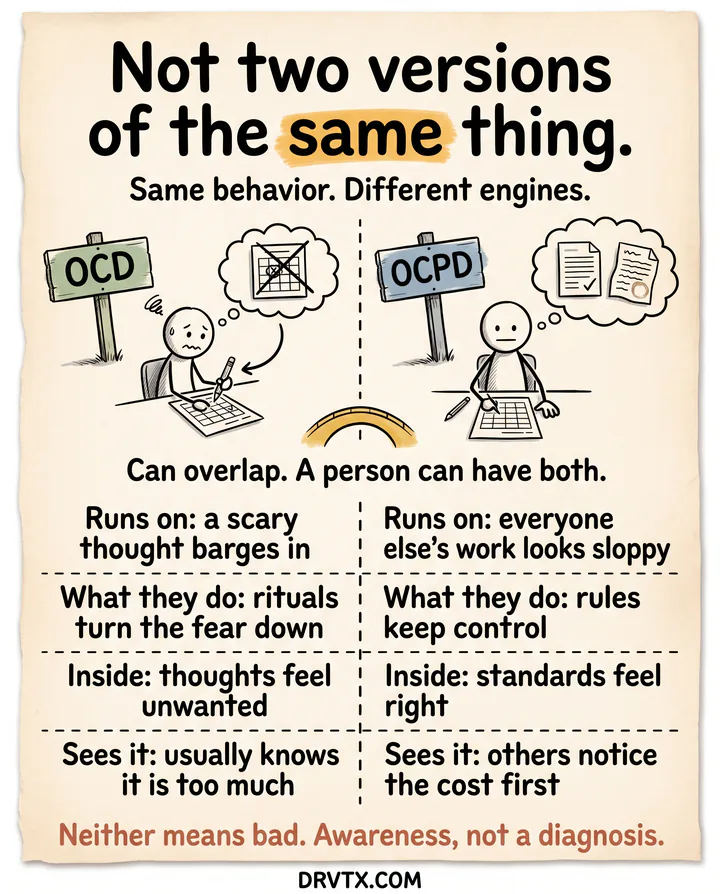
OCD is unwanted thoughts that feel wrong, plus rituals to calm the fear. OCPD is a long-standing pattern of rules and high standards that feel right to you, with the cost showing up in work hours, relationships and rest. They can occur together. Counseling can help with both, using different tools.
People often tell me, I'm a little OCD. They like a tidy desk, or they rewrite an email three times. Sometimes that is just personality. Sometimes it is obsessive-compulsive disorder (OCD). And sometimes it is a condition with a similar name that feels very different: obsessive-compulsive personality disorder (OCPD).
With OCD, unwanted thoughts feel wrong, and rituals calm the fear. With OCPD, rules and high standards feel right, and the cost shows up in work hours, relationships and rest. See which one sounds like you, or like someone you love.
What does OCD feel like from the inside?
OCD usually has two parts. Obsessions are unwanted thoughts or urges that keep coming back and stir up fear or distress. Compulsions are repeated actions or mental acts you feel driven to do in response, like washing, checking or counting (American Psychiatric Association, or APA (opens in a new tab)).
Some rituals happen only in your head, such as replaying an event to make sure nothing bad happened. The ritual is meant to cancel out the thought and ease the distress, but the relief is short (International OCD Foundation, or IOCDF (opens in a new tab)). So the cycle repeats.
The thoughts feel foreign and upsetting. Clinicians call this ego-dystonic, which in plain words means this doesn't feel like me. Someone who would never hurt anyone may be haunted by a thought of harm.
The APA notes that most people with OCD see the thoughts as excessive or unreasonable, yet they still struggle to stop them (APA (opens in a new tab)). Some people are less sure their fears are unrealistic.
Asking Are you sure the stove is off? again and again can be a compulsion too. The IOCDF lists "Telling, asking, or confessing to get reassurance" (IOCDF (opens in a new tab)).
What makes it OCD, and not a habit? The obsessions and compulsions take up a lot of time (for example, more than an hour a day), cause real distress, or get in the way of daily life. A tidy desk alone is not OCD, though an extreme need for order or symmetry can be part of it. About 1 to 2 percent of people in the United States have OCD (APA (opens in a new tab)).
What does OCPD feel like from the inside?
OCPD is one of 10 personality disorders in the DSM-5-TR, the manual clinicians use to diagnose. A personality disorder is a pattern of thinking, feeling and behaving that differs from what your culture expects, causes distress or problems, and lasts over time (APA (opens in a new tab)). The APA describes OCPD as a pattern of perfectionism, tightness with money, stubbornness and inflexibility.
Common signs, according to MedlinePlus (opens in a new tab) from the National Library of Medicine, include:
- Being preoccupied with details, rules and lists
- Perfectionism that gets in the way of finishing tasks
- Being over-devoted to work
- Not wanting to let other people do things
- Trouble throwing things away, even things with no value
- A lack of flexibility
MedlinePlus says people with OCPD "believe that their thoughts are correct" (MedlinePlus (opens in a new tab)). Clinicians call this ego-syntonic: the standards feel like you. Use these two words as a guide, not a test.
Culture matters. Working hard and doing things the right way are valued in many families and communities, and that alone is not a disorder. The question is whether the pattern goes well beyond what is expected and costs you or others. MedlinePlus lists anxiety, depression, trouble moving forward at work and strained relationships as possible complications (MedlinePlus (opens in a new tab)).
Depending on the study, about 2 to 8 percent of the general population has OCPD (Pinto et al., 2022 (opens in a new tab); Diedrich & Voderholzer, 2015 (opens in a new tab)).
How do OCD and OCPD compare side by side?
| OCD | OCPD | |
|---|---|---|
| What it is | Unwanted thoughts (obsessions) and repeated rituals (compulsions) | A long-standing pattern of perfectionism, order and control |
| How it feels | Wrong, scary, not me (ego-dystonic) | Right, responsible, just how it should be done (ego-syntonic) |
| What drives it | Easing fear or doubt | Keeping standards and control |
| Where the cost shows up | Hours lost to rituals, plus distress | Work hours, relationships, rest |
| What counseling often uses | Exposure and response prevention (ERP), a form of cognitive behavioral therapy (CBT): facing fears without doing the ritual | CBT for perfectionism, plus values and flexibility work |
Can you have OCD and OCPD together?
Yes. A 2021 review that combined 34 studies found OCPD in about 25 percent of people with OCD (Pozza et al., 2021 (opens in a new tab)). A 2026 study of 300 people at an OCD clinic found 18.6 percent had both (Girone et al., 2026 (opens in a new tab)).
In that study, people with both went longer before starting treatment: about 9 years on average, compared with about 6 for OCD alone. The authors suggest that OCPD beliefs, because they feel right, may delay getting help.
One question can help sort it out: what is the behavior for? If you recheck a spreadsheet because a doubt feels dangerous, that points to OCD. If you recheck it because good enough feels wrong, that points to OCPD. If both are true at different times, you may have both.
Why do people with OCPD often come in for something else?
A pattern I often see: people with OCPD do not call me about their rules. They call about stress, burnout, anger or poor sleep. Or a spouse, a parent or a boss said something. When the rules feel right, there is nothing to fix, so the strain shows up somewhere else.
The APA notes that some people with personality disorders may not recognize a problem (APA (opens in a new tab)). If low mood is part of your picture, my article on depression symptoms and support may help too.
If someone else pushed you to come, that is a fine place to start. You only need to be curious.
How can counseling help?
Counseling looks different for each, because the engines are different. I am a Licensed Professional Counselor with 20+ years of experience.
For OCD, I use exposure and response prevention (ERP), a form of CBT, often combined with acceptance and commitment therapy (ACT) skills such as urge surfing. CBT works on how thoughts, feelings and actions feed each other. In ERP, you face a feared thought or situation on purpose, a little at a time (National Institute of Mental Health, or NIMH (opens in a new tab)). Then you choose not to do the ritual, and that includes asking for reassurance (IOCDF (opens in a new tab)).
We build the steps together, at a pace you agree to. Urge surfing means noticing an urge rise, peak and fade without acting on it, like riding a wave. ACT skills help you make room for discomfort while you act on what matters to you.
The APA calls ERP the first-line therapy for OCD, meaning the one to try first. It names a group of medicines called SSRIs as the other first-line treatment (APA (opens in a new tab)). NIMH notes that antidepressants like these can take 8 to 12 weeks to start helping (NIMH (opens in a new tab)).
I do not prescribe medication. A physician or psychiatrist can talk through that with you.
For OCPD and perfectionism, we do not throw out your standards. We help you choose them. In CBT for perfectionism, we try small experiments: sending an email after one read, leaving work at a set time, letting a teammate do it their way. We also practice noticing the urge to fix or control, and letting it pass. And I do values and flexibility work: what matters most to you, and which rules truly serve it.
A 2022 review of 15 trials found that CBT for perfectionism reduced perfectionism and eased symptoms of depression and anxiety. Trials were few, and the average age was 23 (Galloway et al., 2022 (opens in a new tab)). For OCPD itself, a 2015 review found that CBT had the strongest evidence so far (Diedrich & Voderholzer, 2015 (opens in a new tab)). A 2022 review adds that no treatment is firmly established yet (Pinto et al., 2022 (opens in a new tab)).
How can family respond?
With OCD. Helping a loved one with OCD feels natural. You answer the same question for the tenth time. You wait while rituals finish. Researchers call this family accommodation.
A review reported that almost 90 percent of family members do it to some degree, and more of it goes with more severe symptoms (Lebowitz et al., 2016 (opens in a new tab)). It comes from love. It can also keep the loop going.
That is why newer treatments often focus on helping families cut back on it (Lebowitz et al., 2016 (opens in a new tab)). Try naming the OCD, not the person: That sounds like the OCD asking. Offer warmth in place of the answer: I can see this is hard. I'm not going to answer that again, because I know you can handle this feeling. Make changes together, ideally with a therapist, instead of stopping all at once.
With OCPD. Arguing about the rules rarely works, because to your loved one the rules feel right. Talk about the cost instead: I miss you at dinner lands better than you work too much.
Ask for one change at a time, and notice small bends. Skip labels, because hearing you have OCPD can feel like an attack. And look after yourself: the APA notes that family members may benefit from talking with a mental health provider (APA (opens in a new tab)).
With kids and teens. OCD often begins in childhood, the teen years or early adulthood (APA (opens in a new tab)). Personality disorders, including OCPD, are not usually diagnosed before age 18, because personality is still developing (APA (opens in a new tab)). When I see kids and teens, parents are part of the team.
Try a self-check
Two private questionnaires on my website can help you reflect: Perfectionism and Rigid Standards and the OCD self-check. They take a few minutes, nothing is saved, and they are not a diagnosis.
Take the perfectionism self-checkCommon questions
Is OCPD just being a perfectionist?
Not quite. Many people have high standards that bend when life asks. OCPD is a long-standing pattern of rigid standards and control that costs you time, rest or relationships.
Is there a medication for OCPD?
The APA says no medications are specifically used to treat personality disorders (APA (opens in a new tab)). MedlinePlus says talk therapy is thought to be the most effective treatment. Medicine may ease anxiety and depression that come with OCPD (MedlinePlus (opens in a new tab)). A 2022 review found only two trials of medicine for OCPD, and judged the evidence very low in certainty (Gecaite-Stonciene et al., 2022 (opens in a new tab)). Your physician or psychiatrist can talk through options.
Can I do counseling online?
Adults can meet with me online anywhere in Texas, or in person in Sugar Land. Kids and teens meet in person in Sugar Land, and in some cases online, when we agree together with you and your child or teen that it's a good fit. Sessions are in English, Hindi or Gujarati.
Where do I start?
You do not need a diagnosis, or a crisis, to ask. If some of this sounds familiar, book a free 15-minute call. It is a short consultation, not counseling. We can talk about what you notice and whether we are a good fit.
This free 15-minute call does not establish a therapist-client/patient relationship as this is not counseling and/or life coaching.
Sources
- American Psychiatric Association. What Is Obsessive-Compulsive Disorder? (physician review, September 2024). https://www.psychiatry.org/patients-families/obsessive-compulsive-disorder/what-is-obsessive-compulsive-disorder (opens in a new tab)
- American Psychiatric Association. What Are Personality Disorders? (physician review, November 2024). https://www.psychiatry.org/patients-families/personality-disorders/what-are-personality-disorders (opens in a new tab)
- MedlinePlus, National Library of Medicine. Obsessive-compulsive personality disorder (review date October 2024). https://medlineplus.gov/ency/article/000942.htm (opens in a new tab)
- International OCD Foundation. About OCD. https://iocdf.org/about-ocd/ (opens in a new tab)
- International OCD Foundation. Exposure and Response Prevention (ERP). https://iocdf.org/about-ocd/treatment/erp/ (opens in a new tab)
- National Institute of Mental Health (NIMH). Obsessive-Compulsive Disorder: When Unwanted Thoughts or Repetitive Behaviors Take Over (revised 2023). https://www.nimh.nih.gov/health/publications/obsessive-compulsive-disorder-when-unwanted-thoughts-or-repetitive-behaviors-take-over (opens in a new tab)
- Pinto A, Teller J, Wheaton MG. Obsessive-compulsive personality disorder: a review of symptomatology, impact on functioning, and treatment. Focus (American Psychiatric Publishing), 2022. https://pubmed.ncbi.nlm.nih.gov/37200888/ (opens in a new tab)
- Diedrich A, Voderholzer U. Obsessive-compulsive personality disorder: a current review. Current Psychiatry Reports, 2015. https://pubmed.ncbi.nlm.nih.gov/25617042/ (opens in a new tab)
- Pozza A, et al. Obsessive-compulsive personality disorder co-occurring in individuals with obsessive-compulsive disorder: a systematic review and meta-analysis. Harvard Review of Psychiatry, 2021. https://pubmed.ncbi.nlm.nih.gov/33666394/ (opens in a new tab)
- Girone N, et al. Is comorbid obsessive-compulsive personality disorder responsible for a longer duration of untreated illness in obsessive-compulsive disorder? Journal of Psychiatric Research, 2026. https://pubmed.ncbi.nlm.nih.gov/41880973/ (opens in a new tab)
- Galloway R, et al. The efficacy of randomised controlled trials of cognitive behaviour therapy for perfectionism: a systematic review and meta-analysis. Cognitive Behaviour Therapy, 2022. https://pubmed.ncbi.nlm.nih.gov/34346282/ (opens in a new tab)
- Lebowitz ER, Panza KE, Bloch MH. Family accommodation in obsessive-compulsive and anxiety disorders: a five-year update. Expert Review of Neurotherapeutics, 2016. https://pmc.ncbi.nlm.nih.gov/articles/PMC4895189/ (opens in a new tab)
- Gecaite-Stonciene J, et al. Efficacy and tolerability of pharmacotherapy for obsessive-compulsive personality disorder: a systematic review of randomized controlled trials. Expert Opinion on Pharmacotherapy, 2022. https://pubmed.ncbi.nlm.nih.gov/35818708/ (opens in a new tab)
This article is general information, not a diagnosis or a substitute for care. If you are in crisis, call or text 988, or call 911.